How the Hippo Claims Process Actually Works (Step-by-Step)

Filing a homeowners insurance claim is stressful enough without trying to figure out what happens next at every stage. This guide walks you through the Hippo claims process from start to finish; what to do first, what an adjuster looks for, how payments work, and what to do if something goes wrong. Timelines and coverage vary by policy and state, so treat this as a practical process map rather than a guarantee of any specific outcome.
At a glance: the Hippo claims process (step-by-step)
Here is what typically happens from the moment you have a loss to the time your claim closes:
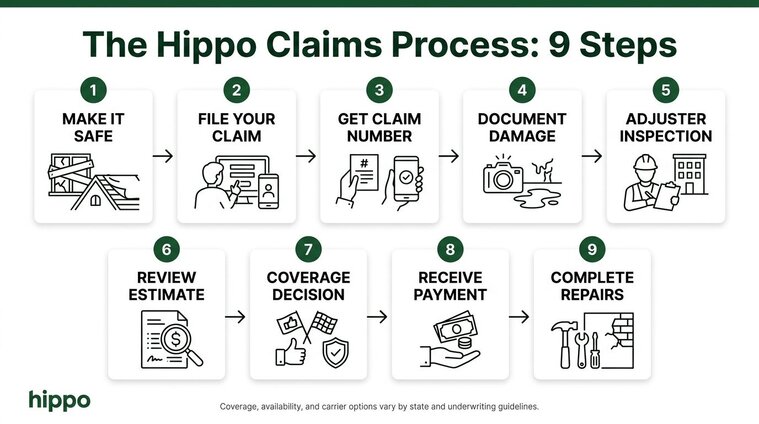
Step 1 — Make the situation safe and prevent more damage. Turn off water at the main shutoff, board up broken windows, tarp a damaged roof section. Stopping further damage is your immediate priority, and reasonable mitigation costs are typically reimbursable.
Step 2 — Start your claim and get a claim number. File through Hippo’s official channel (app, online portal, or phone). You will receive a claim number that tracks everything from this point forward.
Step 3 — Complete intake. A claims specialist will gather the date and time of the loss, the cause, the affected rooms and systems, and your contact details.
Step 4 — Document the loss. Photograph and video everything before any cleanup. List damaged items, including serial numbers for electronics and appliances. Keep every receipt for emergency expenses.
Step 5 — Schedule the adjuster inspection. Hippo’s team will arrange for an adjuster — in-person or virtual — to review the damage. Be available, give access to all affected areas, and walk through the damage together if possible.
Step 6 — Review the coverage decision. The adjuster produces a scope of loss. The claims team then determines what is covered under your policy, what falls under your deductible, and how the loss will be settled — replacement cost or actual cash value.
Step 7 — Receive the estimate and dispute it if needed. You will get a written estimate of the covered loss. If your contractor’s estimate differs significantly from the insurer’s, you can request a re-inspection or submit a formal supplement.
Step 8 — Receive payment. Once the estimate is agreed, the carrier issues payment minus your deductible. If your policy pays replacement cost value, you may receive an initial actual cash value payment first, with the withheld depreciation released after repairs are complete.
Step 9 — Complete repairs and close the claim. Work with your contractor to complete repairs. Submit proof of completion and paid invoices if your policy requires them to release withheld depreciation. Keep all documentation until the claim is fully closed.
Actual Cash Value (ACV) means the insurer calculates the current depreciated value of the damaged property. A five-year-old roof is worth less than a new one, so ACV reflects that reduced value. Replacement Cost Value (RCV) means you are reimbursed for the cost of replacing or repairing the damage with equivalent new materials, without deducting for age or wear. Many policies pay ACV initially and then release the withheld depreciation — called recoverable depreciation — once you provide proof that repairs are complete. If your policy is ACV-only, there is no second payment; the first check is your settlement.
If your home has a mortgage, your lender is typically named as a loss payee on the policy. This means the insurer issues a check made out to both you and the lender. Your mortgage servicer will have its own process for endorsing the check and releasing funds in draws as repairs are completed. Contact them early because this step can add weeks if you are not prepared.
Hippo claim timeline: what affects how long it takes
Simple claims with clear documentation can often move from filing to initial payment in a few weeks. More complex claims — large structural losses, significant personal property inventories, or claims that involve coverage disputes — can take several months. Catastrophe events like regional storms or wildfires stretch timelines considerably because adjusters are handling many claims simultaneously and contractors are in short supply.
What speeds a claim: submitting complete documentation at the time of filing, providing easy and flexible access for inspections, working with a contractor who communicates clearly with the adjuster, and responding promptly when the claims team asks for additional information.
What slows a claim: missing photos or receipts that require follow-up requests, hard-to-schedule inspection appointments, disputes about coverage scope, estimate gaps between your contractor and the insurer, and unavoidable administrative delays during catastrophe periods.
Common mistakes that slow claims — and how to avoid them
Do not wait to file. Some policyholders delay filing while they assess the damage or wait for a contractor’s estimate. Most policies have a notice requirement, and delays can complicate coverage. File as soon as practical after the loss.
Do not throw away damaged items before the adjuster sees them. Keep broken materials, damaged appliances, or ruined belongings in place until they can be inspected or until you get written permission to dispose of them. Photos alone may not be sufficient for high-value items.
Do not skip the mitigation step. Failing to take reasonable steps to prevent additional damage after a covered loss can reduce what you are entitled to receive. A small water leak that is not contained can become a major mold remediation claim that is partially your responsibility.
Do not sign over your claim rights to a contractor without understanding what you are signing. Assignment of Benefits (AOB) agreements transfer your insurance rights to the contractor. AOB laws and restrictions vary by state, and some states limit or regulate how these agreements can be used. Read any contractor agreement carefully, and check with your state's Department of Insurance if you have questions about AOB rules where you live.
Getting a Claim Started
How do I file a claim with Hippo?
File through your Hippo account portal, the app (if available in your state), or call the claims number on your declarations page. Your claim number is issued right after you submit. Have your policy number, loss date and cause, and a list of affected areas ready.
How long does a Hippo claim take?
Timing varies widely. Small, well-documented claims can resolve in a few weeks. Complex structural losses or those involving coverage disputes can take months.Most states mandate minimum acknowledgment and investigation windows, though specific requirements vary, check your state's insurance regulations or Department of Insurance for the exact timelines that apply to you.
Will an adjuster visit my home?
For most significant structural claims, yes. Some smaller or straightforward claims may use a virtual review. Your claims contact will tell you what to expect for your specific situation.
Can I start repairs before the adjuster visits?
Temporary repairs to prevent more damage are generally fine and often required. Permanent repairs should usually wait until after inspection — or until you have explicit approval from your claims team — so the original scope of damage can be properly documented.
What is a supplement?
A supplement is a formal request to add damage or costs that were not part of the original estimate. If your contractor finds hidden damage during repairs, they document it and submit a supplement to the insurer for review.
What if my claim is denied?
Request the denial in writing and review the exact policy language cited. You can submit additional evidence and request a re-review, escalate to a supervisor, or file a complaint with your state Department of Insurance if you believe the denial was improper.
Will filing a claim raise my premium?
A claim may affect your renewal premium, though the impact depends on the claim type, your claim history, your state’s regulations, and your specific carrier. One large claim for a covered event typically has less impact than multiple smaller claims filed in quick succession.
Understanding the Hippo claims process before you need it can make the situation even more manageable. Document the damage thoroughly, file as soon as possible, keep every receipt, and communicate consistently with your claims contact. The more organized you are at each stage, the more control you have over the timeline and outcome.
—
This article is for informational purposes only. While we believe this information to be reliable, we do not guarantee its accuracy or completeness. For any insurance-related decision, please consult your licensed insurance producer.
Related articles

Hippo Housepower Report: Homeowners Gain Ground, Face New Challenges in 2026

Is Your Fixer-Upper a Mistake? 1 in 5 U.S. Homeowners Said Yes

The insurance coverage gap: 40% of homeowners are opting out of additional protection

Hippo's 2026 Homeowner Anxiety Report

Maintenance Checklists for New Homeowners